
Turntable vs rotary arm vs in-line pallet wrapper: which one do you need?
7 min read
Reviewed and updated by the iPack engineering team.
In short
A turntable wrapper spins the load and suits forklift-fed dispatch at 20–30 pallets per hour. A rotary arm keeps the load still and rotates the film instead, which is what tall, heavy or unstable loads need, at up to 35 pallets per hour. An in-line wrapper uses a powered roller turntable so pallets arrive and leave on a conveyor with no forklift — 20–40 pallets per hour on an automated line.
01The short answer
All three wrap a pallet with stretch film. The difference is what moves during the cycle, and that single decision determines throughput, the loads you can handle, whether a forklift is needed, and how the machine fits your building.
| Turntable | Rotary arm | In-line roller turntable | |
|---|---|---|---|
| What moves | The load rotates | The arm rotates, load still | The load rotates on a roller deck |
| iPack model | SW-5000D | SW-6000D | SW-7000D |
| Throughput | 20–30 pallets/hour | 15–35 pallets/hour | 20–40 pallets/hour |
| Load fed by | Forklift | Conveyor | Conveyor |
| Load capacity | 2 000 kg | 1 000–1 200 kg | 100–1 500 kg |
| Unstable loads | Needs top press | Ideal — never spun | Needs top press |
| Floor space | Smallest | Large gantry footprint | Needs infeed and outfeed |
| Film yield | 200 % | 200 % | 250 % |
| Line integration | Standalone | Dry-contact I/O | PLC ports, full interlock |
02Turntable: the default for forklift-fed dispatch
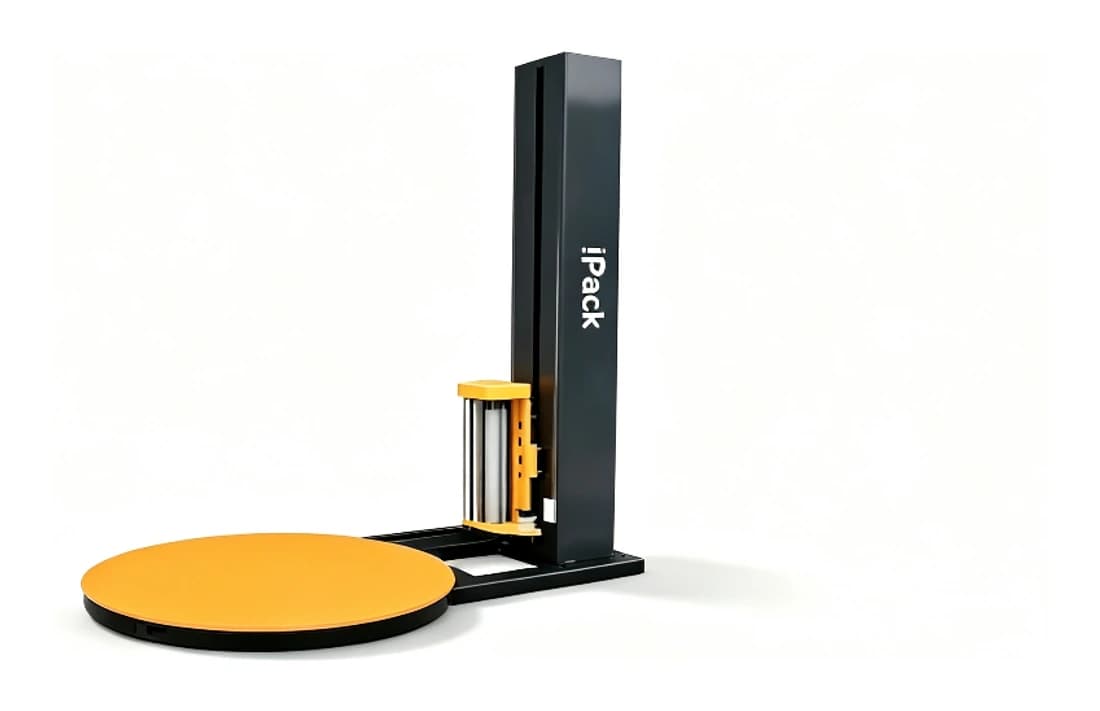
The turntable is the simplest architecture and the one most operations should start with. The pallet is placed on a rotating deck, the film carriage travels up a fixed column, and the machine does not care what happens upstream or downstream.
The SW-5000D carries 2 000 kg on a φ1 650 mm turntable, runs a 200 % pre-stretch carriage, and installs on a single-phase 220 V supply — which matters in an existing warehouse where a three-phase feed is not available. Cycle times of 20–30 pallets per hour are set by the wrap count, not by the machine.
- Choose it when a forklift already delivers pallets to the dispatch area
- Choose it when the load is stable and can be spun safely
- Add a pneumatic top press for light, tall or bagged loads
- Add the SW-1000D top-sheet module when the load is stored outside
03Rotary arm: for loads that must not be rotated
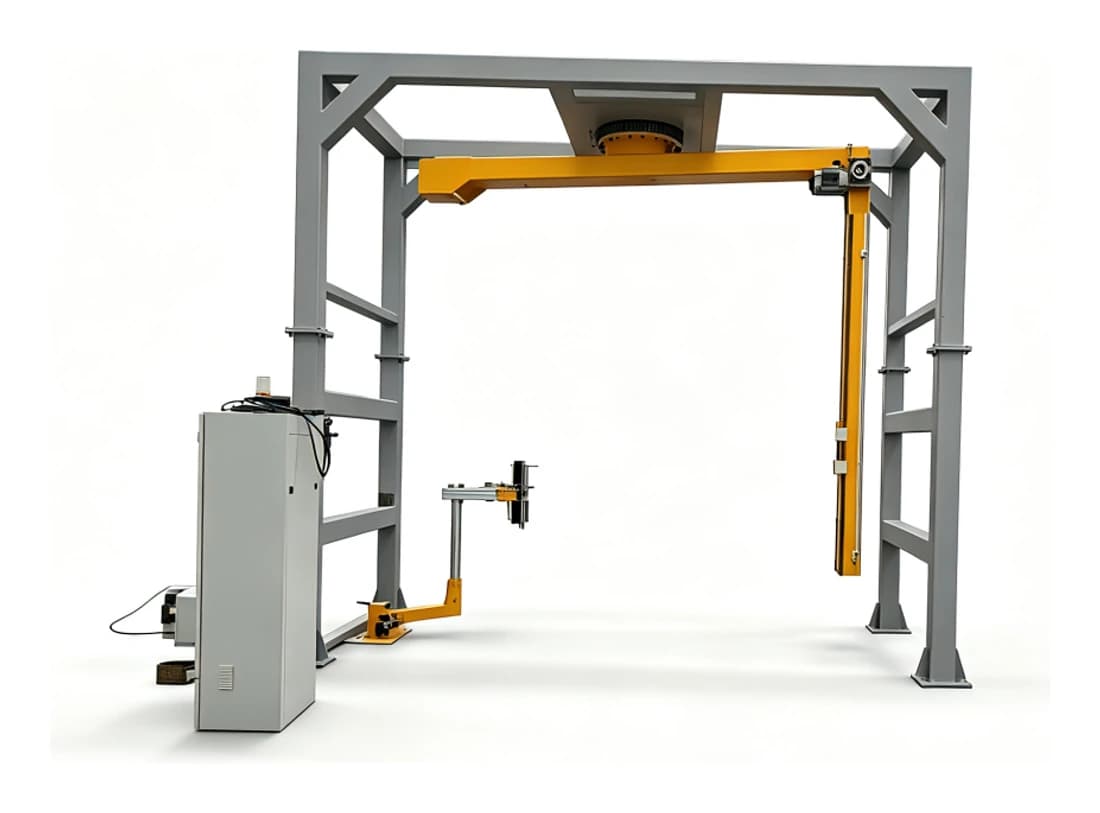
Some loads simply cannot be spun. Tall stacks, half-full drums, unstable bagged product and anything with a high centre of gravity will shift or shed material the moment the deck turns. A rotary arm solves that by keeping the pallet stationary on the conveyor while the arm carries the film around it.
The SW-6000D runs the arm at 0–15 rpm with a 1.1 kW helical-gear motor and an electromagnetic brake for accurate stopping. Standard dry-contact I/O for load-in, load-out and ready lets it behave like another station on the line rather than a machine bolted next to it.
04In-line roller turntable: removing the forklift entirely
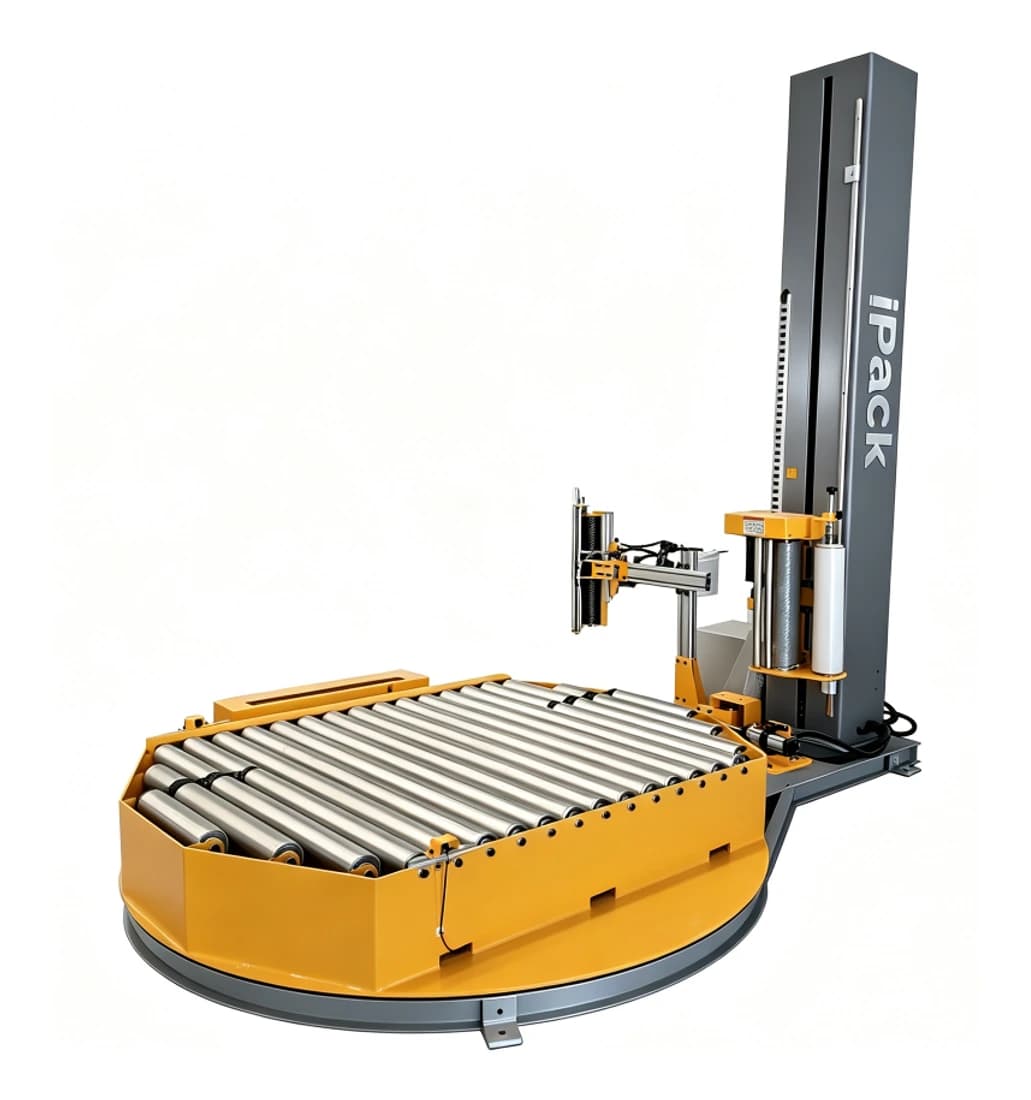
The largest labour saving in pallet wrapping is not the wrapping — it is the forklift trip to and from the machine. An in-line wrapper replaces the plain turntable deck with a powered roller conveyor, so the pallet rolls on from your line, is wrapped and sealed, and rolls off again.
The SW-7000D runs φ89 mm rollers on a 100 mm pitch, handles 100–1 500 kg, and reaches 250 % film yield — the highest in the range. Photoelectric sensors sequence the whole cycle and standard PLC communication ports let it interlock with your line controller.
05What actually drives the cost
The purchase price is rarely the deciding number in this category. Three running factors matter more over a five-year life:
- Film consumption — the gap between 200 % and 250 % pre-stretch is roughly a fifth of everything you spend on film
- Forklift time at the wrapper — an in-line machine removes this cost entirely, and it is usually the largest single saving on the project
- Changeover time between products — a touchscreen recipe makes it a button press; a mechanical setting makes it a five-minute stop
Frequently asked questions
Can a turntable wrapper be upgraded to an in-line one later?
+
Not economically — the turntable deck and the machine base are different assemblies, and the conveyor infeed/outfeed has to be built into the layout. If a conveyor line is planned within two years, specify the in-line machine at the start.
Which architecture gives the lowest film cost per pallet?
+
In-line and top-covering models, because both run the pre-stretch carriage at 250 % rather than 200 %. On a typical pallet that is roughly 20 % less film for the same containment.
Do rotary arm wrappers need a conveyor to work at all?
+
They can be fed at floor level by forklift, but the machine's advantage is line integration. Buying a rotary arm without a conveyor usually means paying for capability you are not using.
Machines referenced in this guide
Get a specification, not a sales pitch
An engineer reads every enquiry. You will get the model that fits, the options you actually need, and a delivery date.